
Client Background
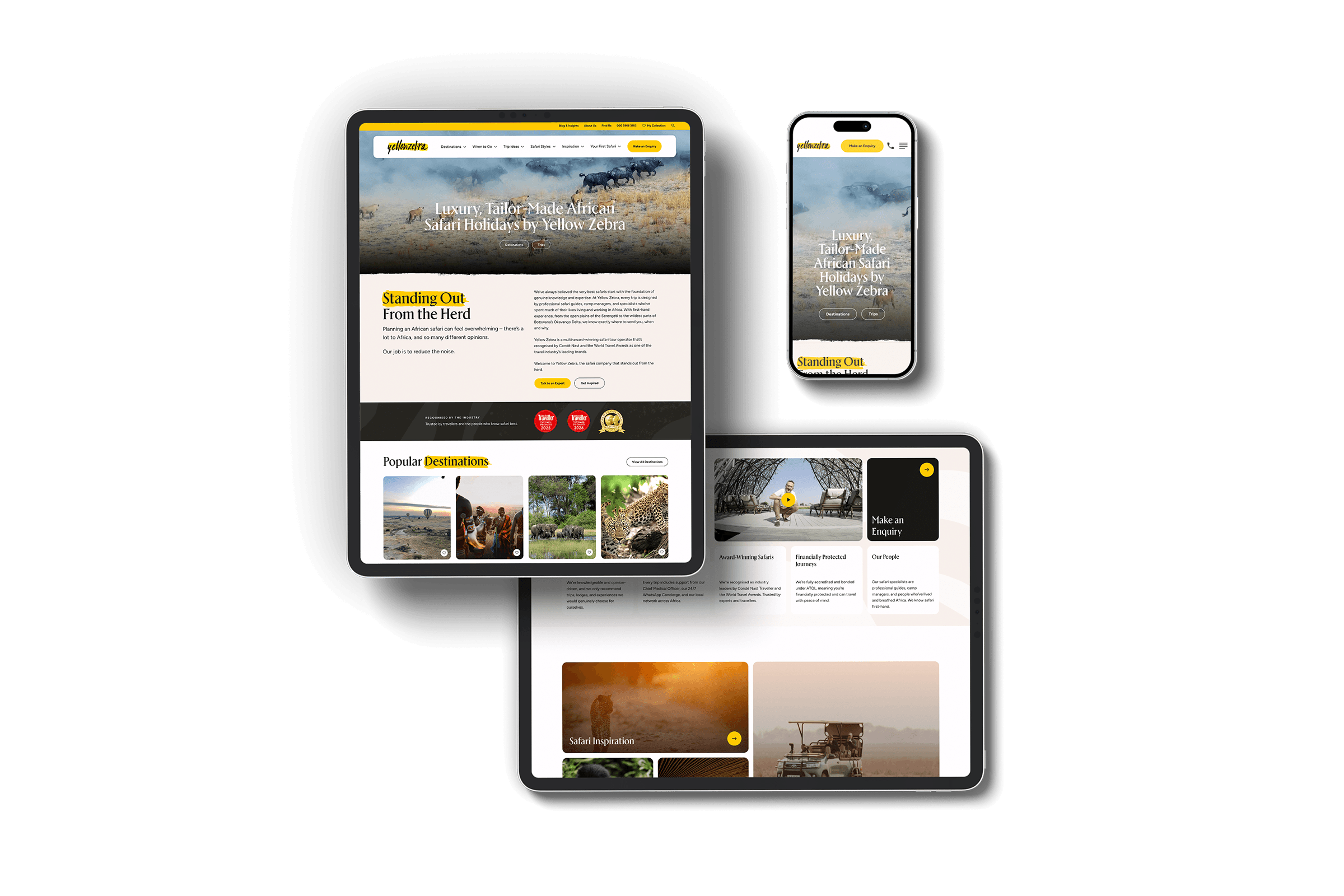
Yellow Zebra is Europe’s leading safari specialist, a title it has held at the World Travel Awards for ten consecutive years offering entirely bespoke safari experiences across Africa. After eight years on its previous platform, the business needed a website that matched the calibre of the trips it sells: a best-in-class, lead-generation travel platform capable of taking the brand into its next chapter of growth.
Their website they had at the time could no longer do that job.
Approach
Vision and Navigation
The vision and navigation of Yellow Zebra’s website had fallen behind with its structure, becoming unwieldy for users and increasingly out of step with how modern search surfaces travel content. Years of content had accumulated with no consistent structure behind it, turning migration into one of the project’s biggest technical challenges. With Yellow Zebra’s safari experiences being entirely tailor-made, built around each traveller rather than sold as fixed packages, the site could never work like a conventional e-commerce build.
Kitty’s job was to generate high-quality enquiries, not transactions and everything about the rebuild was designed around that single measure of success.
Kitty designed and built a new site to serve Yellow Zebra’s four core markets, with genuine localisation rather than a single templated experience: market-specific language and spelling, localised currency, and temperature shown in Fahrenheit or Celsius depending on the audience.
Use of Map
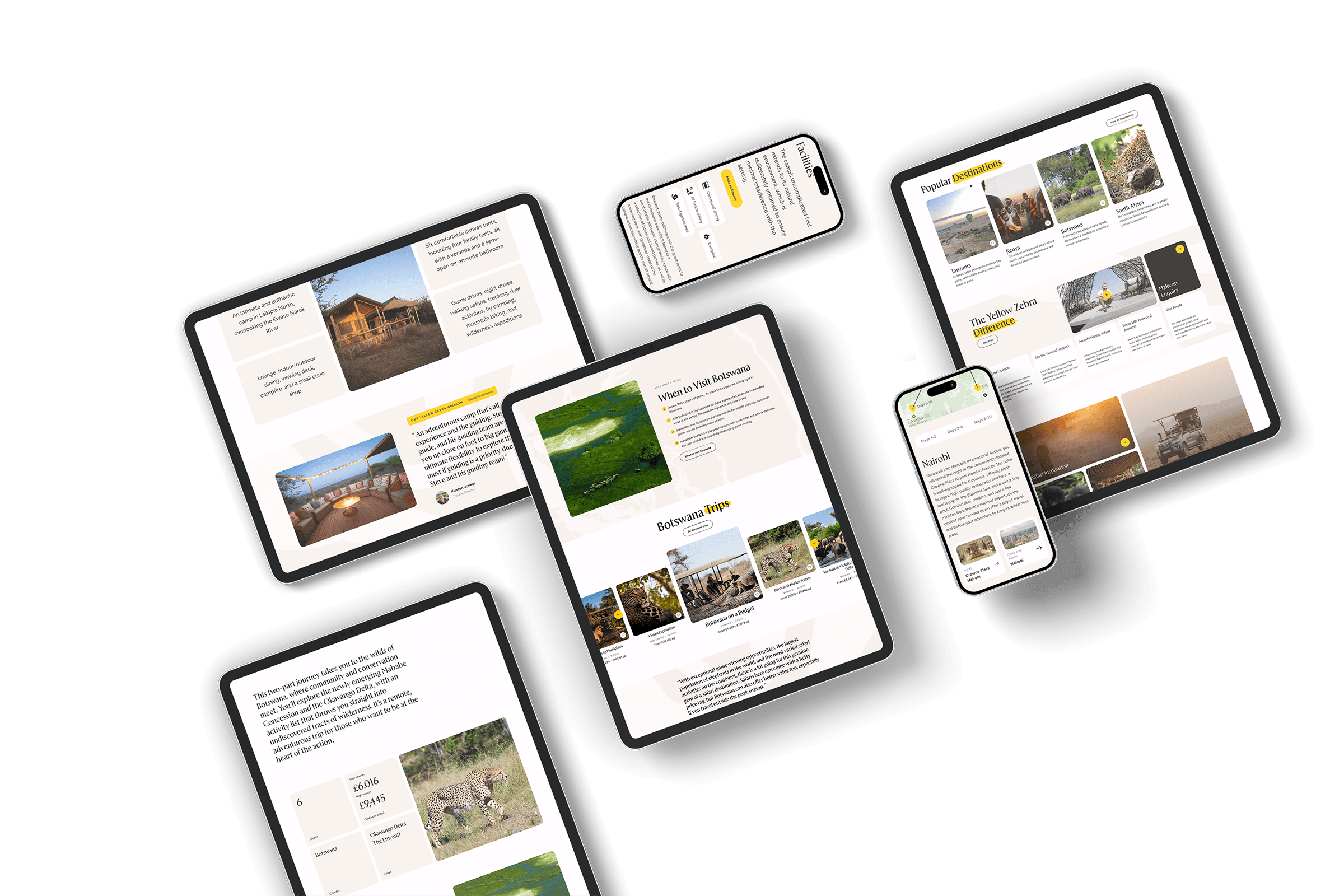
At the heart of the new site is a custom-built interactive map, designed to bring Yellow Zebra’s itineraries to life rather than simply mark them on a pin-map. The Yellow Zebra team can build out each trip on the back end, plotting every stop in sequence. As the user clicks on accommodation cards, the map draws route lines from one trip stop to the next, the map updates to track their position through the itinerary, with each point connected to a corresponding content module elsewhere on the page so a traveller can explore a leg of their trip and watch it plotted, in step, on the map.
It is a heavily custom piece of engineering, built specifically around the way Yellow Zebra’s trips are structured and sold, not an off-the-shelf maps plugin.
Forms and Input
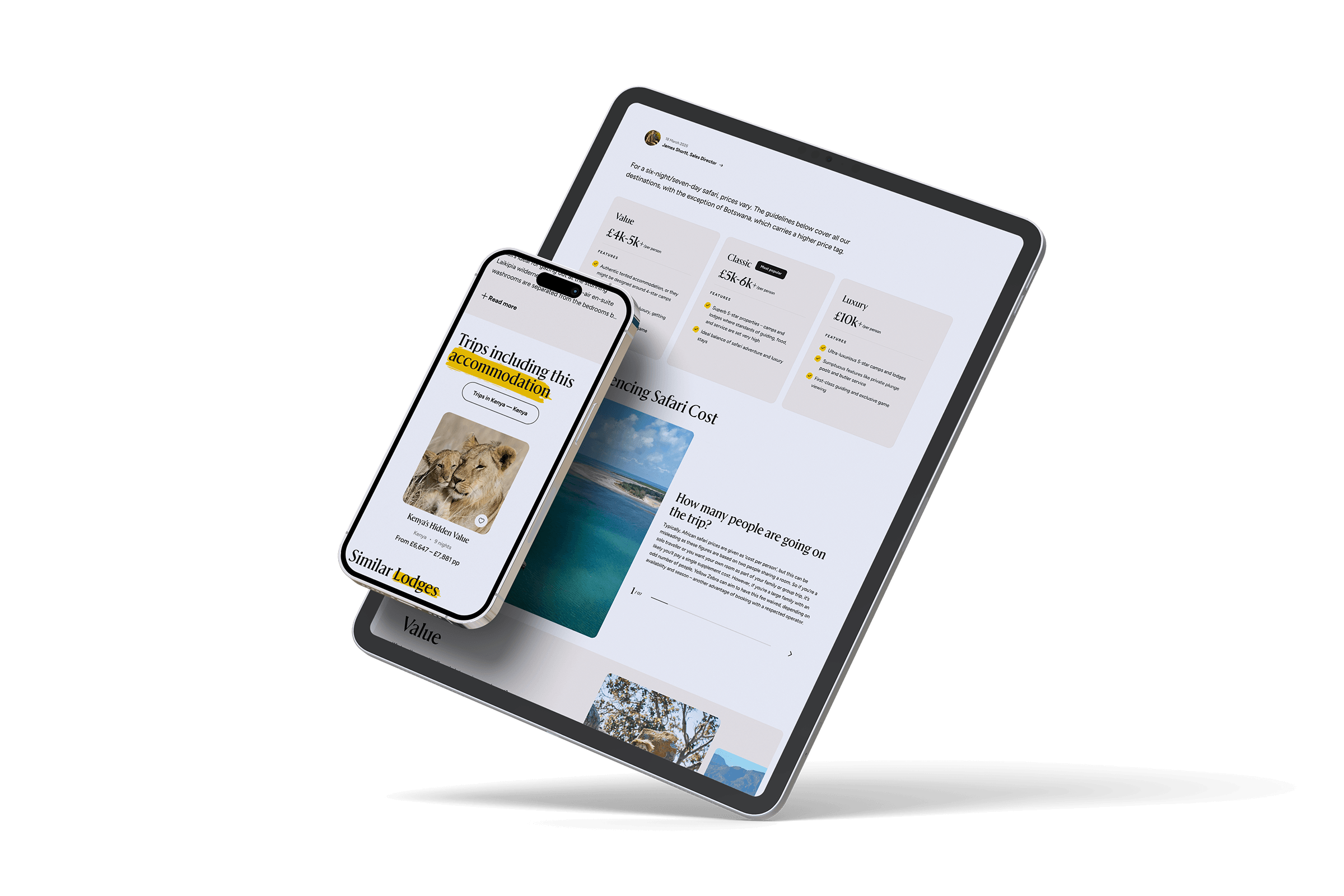
A multi-step enquiry form guides users through the process with every step tracked, paired with a wish list feature that lets visitors save any content type: a lodge, a destination, a safari park. Users can then share that list with fellow travellers planning the same trip.
When a user submits their trip itinerary, the entire wish list is passed into Yellow Zebra’s HubSpot CRM, alongside the users’ enquiry, giving its sales team full visibility of everything a prospective traveller has shown interest in before they ever make contact, turning browsing behaviour into a genuinely useful sales tool, not just a UX flourish.
Smaller Details, Same Thinking
If a visitor tries to add something to their wish list without having accepted cookies, the site doesn’t simply block the action – it prompts them to accept in that moment, turning a point of friction into an opportunity to capture usage data that helps Yellow Zebra keep improving the site for users who might otherwise have opted out entirely.
Behind the scenes, the team can also set manual rankings for lodges and properties, globally or by country, controlling how they are sorted and surfaced across listings pages, giving Yellow Zebra a level of commercial control over merchandising that few travel sites of this kind offer.
The build is underpinned by a heavy, custom schema implementation, 27 distinct schema types spanning business and trust data , destination and property data, commercial signals and on-site structure built to support Yellow Zebra’s visibility and discoverability in an evolving search and AI landscape.
Despite carrying substantially more imagery, video and interactive functionality than its predecessor, the new site holds strong Core Web Vitals, a meaningfully harder benchmark to clear than for the leaner legacy site it replaced.
Results
Early results (14 days of data from June 2026) are promising.
Performance wise early indications were that the new site was converting 2.8% better than the legacy site and generating more page views per session with a 6.5% increase in average session duration.
That’s based on 14 days of data from early June.
Eight years on from its last redesign, and ten years running as Europe’s leading safari company, Yellow Zebra needed a website equal to that reputation, one built not to sell a product off a shelf, but to inspire an enquiry, and to arm its team with everything they need to turn that enquiry into a trip.
That is exactly what this project set out to do and achieved.